
Research
My research program is driven by a singular mission: To design a future of work that works for ALL workers.
Dedicated to ensuring individuals can flourish both within and beyond the workplace, my research is anchored in a humanistic management perspective—where human well-being is the ultimate purpose of organizational life. Drawing on management, psychology, and sociology, I examine how modern work environments can be transformed into human-centered practices that foster worker sustainability and holistic flourishing.
My research agenda unfolds across three core dimensions: The Human Experience, where I examine flourishing, identity dynamics, and holistic health at the work-nonwork interface; the Changing Nature of Work, focusing on how contemporary job design, organizational practices, and technology reshape work and our relationship with it; and the Geography of Work, investigating how spatial flexibility and global mobility transform worker experiences. Ultimately, my work aims to understand how organizations can harness work structures and humanistic practices to cultivate restorative, human-centered workplaces.
Research in Progress
Dissertation: Work from Anywhere as a Pathway to Subjective Well-Being
My dissertation investigates how location-independent work serves as a strategic, human-centered practice for employee well-being. Centering the lived experiences of workers who reside entirely outside their organization’s geographic footprint, this qualitative study illuminates how Work-from-Anywhere (WFA) functions as a vehicle for personal liberation, healthier lifestyles, and economic security. By moving beyond traditional economic and productivity metrics, my research uncovers the specific organizational mechanisms that buffer systemic harm, restore dignity, and turn spatial autonomy into human flourishing.
Current Status: Writing (expected defense Fall 2026)
The Influence of Workplace and other Social Factors on the Global Mobility of Black American Workers
This study centers the voices of those often left at the margins of traditional management theory by examining the self-initiated expatriation of 27 Black American professionals. By integrating organizational and migration theories, the findings reveal that workplace threats and localized systemic frictions act as primary “push” factors that outweigh traditional “pull” factors like career advancement. The work emphasizes that organizations must address internal racial and structural equity if they hope to retain minoritized talent.
Current status: Writing
Research Under Review
Leadership for DEI: A KSAB-based integrative review.
Wilson, M., Neely, B., Gooty, J., Catoe, J., King, E.
Diversity, equity, and inclusion (DEI) has remained a topic of central attention and growing controversy in management and applied psychology for the last five years. Today’s leaders are divided on how best to approach leading in service of DEI. Some have recently announced they will be abandoning one or two of DEI’s components, while others have doubled down in their support of leading across DEI. A key foundational question in this domain remains unanswered, however: a full understanding of which leader knowledge structures, skills, abilities, or behaviors (KSABs) facilitate (or hinder) the outcomes associated with leading for DEI (e.g., workforce diversity, justice perceptions, and well-being) is missing in the current discourse surrounding leadership and DEI. Our proposed review seeks to ameliorate this issue via an integrative review of 82 studies drawn from multiple disciplines, culminating in the development of an integrative theoretical framework that can spur further investigation of the KSABs of leadership for DEI in organizations. In turn, such empirical work can inform future training and development of leaders in fostering climates of inclusion marked by the values of diversity and equity.
Publications
Low-Income Black Mothers Navigating Work and Caregiving During COVID-19
Jason, K., Wilson, M., Catoe, J., Glass, T.S., Lewis, J.B., Patel, K., Monaghan, Q., and Brown, D., (Forthcoming). Low-income Black mothers navigating work and caregiving during COVID-19. Sociological Perspectives. JIF: 1.6
Abstract: The COVID-19 pandemic greatly increased the employment, housing, and childcare insecurity in Black households. Low-wage Black mothers were arguably hit the worst, already overrepresented in low-wage essential work, and now facing greater difficulties sustaining employment and affordable housing. In this study, we interviewed eleven Black mothers receiving services from a transitional housing shelter to explore their work experiences and coping strategies during the pandemic. Applying an intersectionality frame, we found the mothers precarious working conditions were exacerbated by the pandemic, leading to increased uncertainties that impacted their work and ability to care for their families. However, transitional housing support and the consequences of the pandemic introduced new opportunities such as encouraging mothers to create their own employment, more time with their children, and prompting mothers to think differently about their work-life balance. We offer policy challenges. recommendations promoting a living wage, community support systems, and family and finance planning in early education. We contribute to understandings of how vulnerable populations navigate structural racism and racial capitalism by centering the narratives and agency of Black home-insecure mothers within the broader context of structural inequities and systemic
Digital Nomads
(Forthcoming, 2026) The Elgar Encyclopedia of Organizational Sociology
Overview: This encyclopedia entry provides a comprehensive overview of “digital nomadism” as an emerging sociological phenomenon and labor practice. It conceptualizes how advancements in digital infrastructure have decoupled work from fixed geographic localities, giving rise to a highly mobile class of knowledge workers. The article provides a brief synthesis of literature on the subject. Specifically, it explores how digital nomads navigate issues of legal and tax precarity, the stratification of global passport privilege, the commodification of local economies, and the profound blurring of boundaries between labor and leisure.
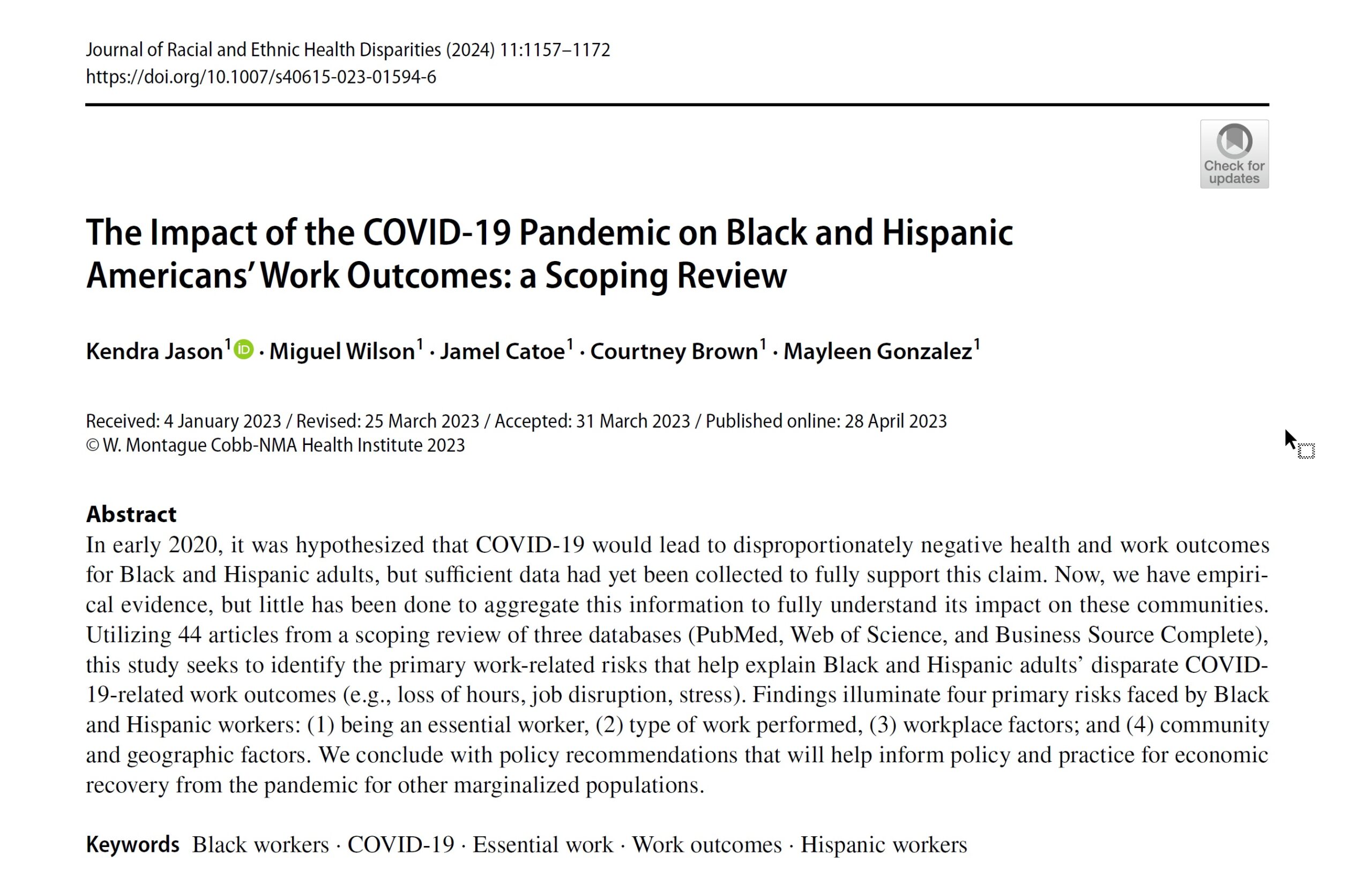
The Impact of the COVID-19 Pandemic on Black and Hispanic Americans’ Work Outcomes: a Scoping Review
Jason, K., Wilson, M., Catoe, J., Brown, C., & Gonzalez, M. (2024). Journal of Racial and Ethnic Health Disparities. JIF: 2.2
Abstract: In early 2020, it was hypothesized that COVID-19 would lead to disproportionately negative health and work outcomes for Black and Hispanic adults, but sufficient data had yet been collected to fully support this claim. Now, we have empirical evidence, but little has been done to aggregate this information to fully understand its impact on these communities. Utilizing 44 articles from a scoping review of three databases (PubMed, Web of Science, and Business Source Complete), this study seeks to identify the primary work-related risks that help explain Black and Hispanic adults’ disparate COVID-19-related work outcomes (e.g., loss of hours, job disruption, stress). Findings illuminate four primary risks faced by Black and Hispanic workers: (1) being an essential worker, (2) type of work performed, (3) workplace factors; and (4) community and geographic factors. We conclude with policy recommendations that will help inform policy and practice for economic recovery from the pandemic for other marginalized populations.
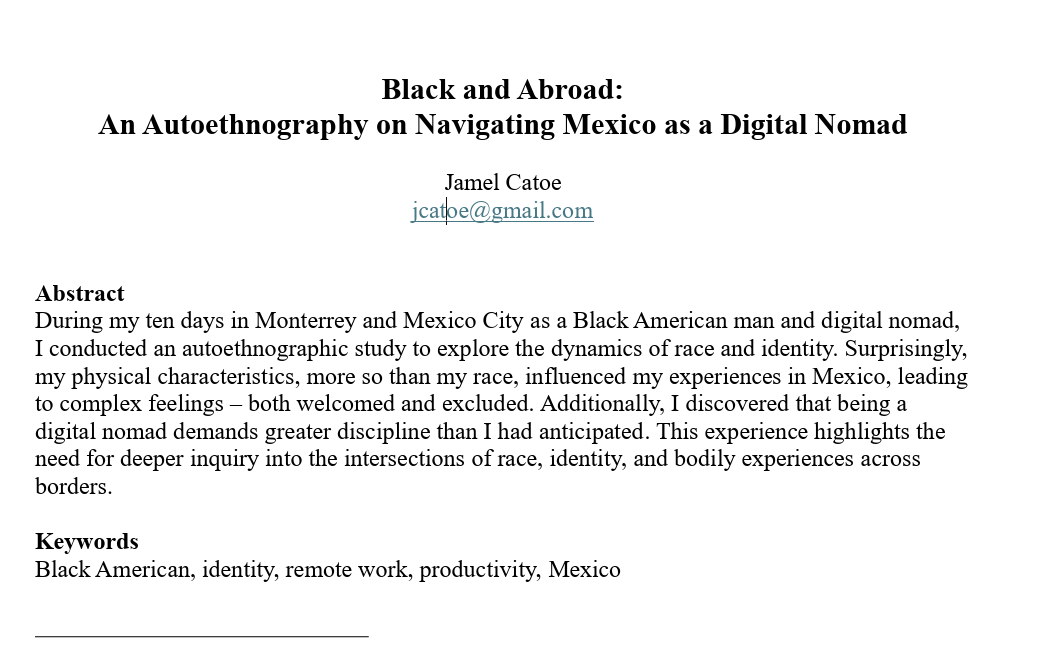
Black and Abroad: An Autoethnography on Navigating Mexico as a Digital Nomad
(2024) Proceedings of the International Symposium of Autoethnography and Narrative
Abstract: During my ten days in Monterrey and Mexico City as a Black American man and digital nomad, I conducted an autoethnographic study to explore the dynamics of race and identity. Surprisingly, my physical characteristics, more so than my race, influenced my experiences in Mexico, leading to complex feelings – both welcomed and excluded. Additionally, I discovered that being a digital nomad demands greater discipline than I had anticipated. This experience highlights the need for deeper inquiry into the intersections of race, identity, and bodily experiences across borders.
© 2026 Jamel Catoe | Designed by Scholarly Studio.